
If you need to sell your home quickly, pricing isn’t just about answering “What is my house worth?”
The better question is:
What price gives me the best combination of value and a realistic timeline?
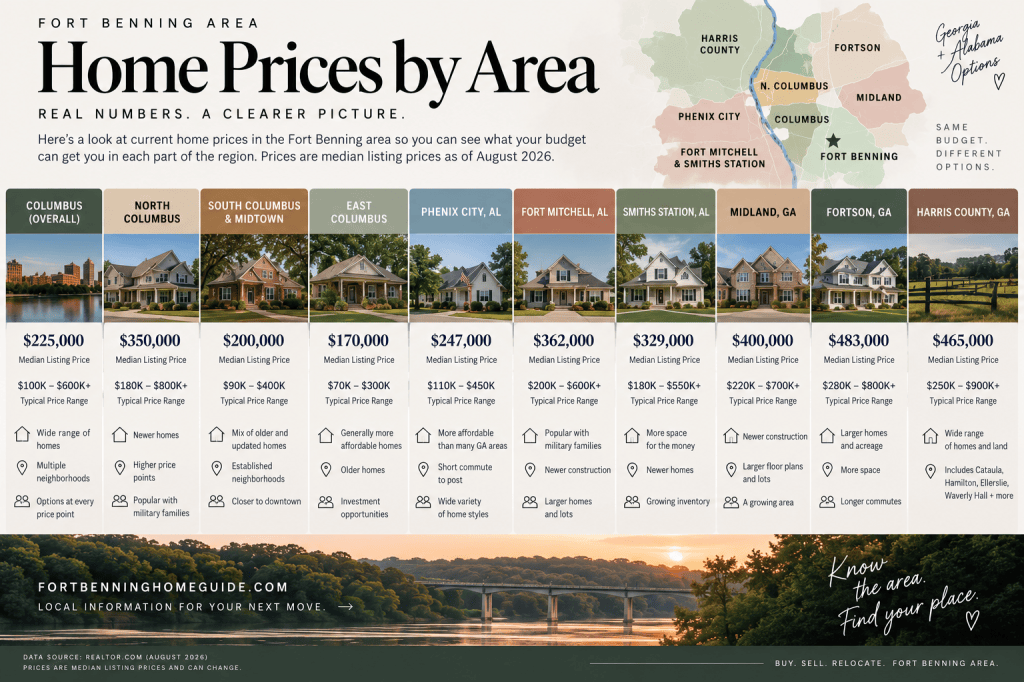
That matters in the Columbus, Georgia area, where buyers may compare homes across North Columbus, Midland, Fortson, Harris County—and even across the river in Phenix City, Fort Mitchell and Smiths Station.
If you have a firm moving deadline, your pricing strategy should account for it from day one.
Start With Your Selling Timeline
If you need to move in 60 days, you don’t necessarily have 60 days to find a buyer.
Once your home is under contract, you’ll still need time for inspections, an appraisal, financing, possible repairs and closing.
That means your actual window for securing an offer could be considerably shorter.
A tight timeline doesn’t mean you need to price below market. It means you need to be intentional about where you price within the range the market supports.
Should You Price at the Higher End of the Range?
A home’s market value isn’t always one exact number.
Recent comparable sales might support a range—for example, $385,000 to $400,000.
If you have plenty of time, positioning toward the higher end may make sense.
If you need to sell relatively quickly, you also have to consider how your home compares with everything else a buyer can purchase in that range.
Starting closer to the middle of a supported range could generate interest sooner. Starting toward the higher end could mean allowing more time for the right buyer to come along.
Neither approach is automatically right or wrong.
Your timeline helps determine how much room you have to test the upper end of the market.
How Do You Determine the Right List Price?
I look at more than recently sold homes.
A strong pricing analysis should consider sold, pending and active listings, because each tells us something different.
Sold listings show what buyers have actually paid. They help establish what the market has recently supported for homes similar to yours.
Pending listings show what buyers are choosing now. We won’t know the final sale price until a property closes, but its list price and days on market can provide useful clues about current buyer behavior.
Active listings show your competition. These are the homes buyers will see next to yours when they’re deciding which properties to tour.
Put the three together and you get a much better picture than you would from an online home-value estimate alone.
Why Hyperlocal Pricing Matters in Columbus, GA
There isn’t one single “Columbus housing market.”
A home in North Columbus may compete with properties in Midland or Fortson. A Fortson buyer may also consider homes farther into Harris County.
Some buyers broaden their search across the Chattahoochee and compare Columbus with Phenix City, Fort Mitchell or Smiths Station.
Those areas can offer different combinations of commute, lot size, home age, taxes, schools, amenities and overall price.
That’s why a broad Columbus average isn’t enough to price an individual property.
The more useful question is:
What else could the buyer most likely to purchase your home buy for roughly the same amount of money?
That’s your real competition.
How Does Your Home’s Condition Affect Price?
Two homes with similar square footage, bedrooms and bathrooms can still deserve different prices.
When comparing homes locally, I look at factors such as:
- Roof and HVAC age
- Kitchen and bathroom updates
- Flooring and paint
- Windows
- Exterior maintenance
- Yard and fencing
- Odors
- Overall cleanliness
- Move-in readiness
This can be particularly important for relocating buyers who may have only a few days to tour homes—or who begin narrowing down properties remotely.
You don’t necessarily need to renovate before selling.
Sometimes the smarter choice is to make a few strategic improvements and price the home’s current condition appropriately.
Do Home Improvements Increase Your Sale Price?
They can, but not necessarily dollar for dollar.
A new roof, HVAC system or renovated kitchen may make your home more attractive compared with nearby competition.
But spending $20,000 on an improvement doesn’t automatically increase market value by $20,000.
Instead, I look at how buyers in your particular area and price range are responding to those features.
For example, a newer HVAC system may become especially valuable from a competitive standpoint if several similar homes currently for sale have older systems.
Updates should be evaluated in the context of your competition, not simply added to the price you hope to receive.
Market Value and Your Net Proceeds Are Different Numbers
What you need to make from the sale doesn’t determine what a buyer will pay.
Before listing, sellers should understand two numbers:
1. What does the current market support?
2. What are you estimated to walk away with at that price?
Your mortgage payoff, estimated selling expenses and expected proceeds can help determine whether selling makes financial sense.
If those numbers don’t work, it’s better to know before the property hits the market.
Depending on your situation, keeping the home as a rental could also be worth evaluating rather than forcing a sale that doesn’t accomplish your financial goals.
What Happens If Your Home Isn’t Getting Offers?
Once your home is listed, buyer activity gives us additional data.
I want to know:
Are buyers scheduling showings?
Are they viewing and saving the listing online?
What feedback are we receiving?
Are similar homes going pending while yours remains active?
Has new competition entered your price range?
A home getting plenty of showings but no offers tells us something different from a home getting very few showings.
The goal is to determine why buyers aren’t moving forward before changing the strategy.
If the evidence points to price and you’re working against a deadline, a meaningful adjustment may be more effective than a series of small reductions over several weeks.
Pricing to Sell Quickly Doesn’t Mean Pricing Low
Pricing strategically is not the same as underpricing.
The goal is to identify the strongest price the current market supports while considering how quickly you need the home to sell.
Sometimes the comparable sales, condition, pending activity and competition support pricing toward the higher end.
Sometimes the data suggests you’ll be better positioned closer to the middle of the range.
That’s why there isn’t one pricing formula that works for every property.
Protect Your First Two Weeks on the Market
When you’re selling on a tight timeline, your first couple of weeks matter.
Your listing is new. Buyers already searching in your price range see another option. Their agents see it too.
That’s also when we begin receiving real-world feedback about how the market perceives your home.
Before choosing a list price, I want to consider:
- Recent comparable sales
- Pending listings and days on market
- Current competing homes
- Your property’s condition and updates
- How quickly similar homes are selling
- Your estimated proceeds
- Your desired closing date
- Your moving deadline
Then we can decide where within the supported range your home should be positioned.
The highest possible list price isn’t necessarily the price that puts the most money in your pocket. And the fastest possible sale isn’t necessarily the goal.
The goal is a pricing strategy that gives you a realistic opportunity to accomplish both your financial goals and your timeline.
Selling a Home in the Fort Benning Area?
I’m Alexandria Bowman, a licensed Georgia and Alabama Realtor serving Columbus and surrounding communities on both sides of the Chattahoochee.
If you’re considering selling and timing matters, I can help you evaluate recent sales, pending activity, current competition and your estimated proceeds to determine where your home fits in today’s market.
No one-size-fits-all pricing formula—just a property-specific strategy built around your home, your market and your timeline.



 fortbenninghomeguide
Leave a comment