
It’s one of the most common questions I hear from military families moving to Fort Benning.
“What if we buy and then get orders again in a year or two?”
It’s a fair question.
After all, military life doesn’t exactly come with guarantees. Assignments change. Timelines shift. A place that feels like home today can become a PCS destination tomorrow.
But when buyers ask me this question, I usually steer the conversation in a different direction.
The real question isn’t whether you’ll get orders again.
The real question is:
What’s the plan if you do?
Orders Aren’t the Risk. Having No Exit Strategy Is.
As a military spouse myself, I understand why this concern comes up.
No one wants to buy a home only to find themselves moving sooner than expected.
But I’ve found that buyers often focus so much on the possibility of future orders that they overlook the bigger picture.
What would happen to the home if you left?
Would you want to sell it?
Would you consider keeping it as a rental?
Would you have the financial flexibility to handle either option?
Those questions usually tell me more than the timeline itself.
Sometimes Renting Is the Better Choice
I know that may sound strange coming from a Realtor, but it’s true.
I’ve absolutely had conversations where I thought renting made more sense than buying.
A few examples:
If a family expects to be here only one to two years and has no interest in keeping the property as a rental, I think it’s worth slowing down and looking at the numbers carefully.
If a buyer has very limited cash reserves, I want to understand how they would handle an unexpected repair, vacancy, or surprise expense.
I’ve also worked with people who previously bought in an area they weren’t familiar with, only to realize later that the location wasn’t a good fit for their lifestyle. In those situations, taking more time to learn the area can be the smarter move.
Buying a home can be a great financial decision.
It’s just not automatically the right decision for every situation.
The Cost of Selling Is Often Overlooked
One of the biggest misconceptions I see is that buyers assume they’ll simply sell the home in a few years and move on.
What many people don’t realize is that selling a home comes with costs.
If you’re using a VA loan with little or no down payment, it can take time to build enough equity to comfortably cover those expenses.
That’s why I encourage buyers to think beyond the monthly payment.
Instead of asking:
“Can we afford this home?”
Ask:
“If we needed to sell this home in two years, what would that look like?”
The answer matters.
Not Every Home Carries the Same Risk
When buyers tell me there’s a chance they could PCS again in the next few years, I pay close attention to the type of home they’re considering.
Contrary to popular belief, I’m not necessarily looking for the newest house or the biggest house.
I’m looking for the home that will appeal to the largest pool of future buyers.
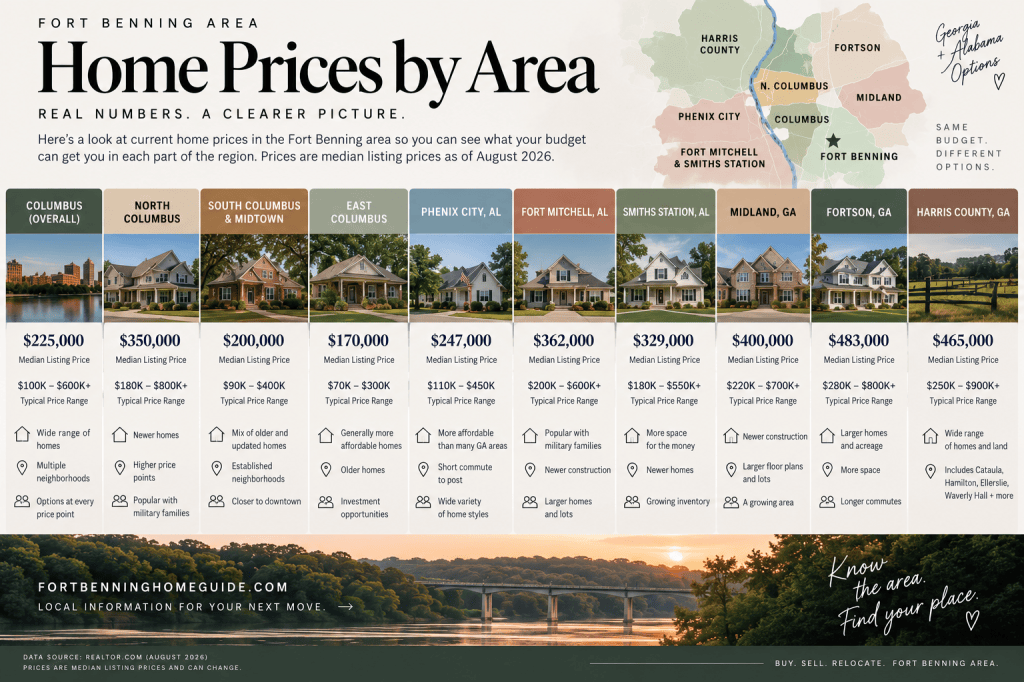
For example, a well-maintained three-bedroom, two-bath home in a desirable area like Fortson at an affordable price point may not be the flashiest option available.
But it may be easier to sell or rent later because it appeals to a wider range of buyers.
When future plans are uncertain, I often encourage families to think about resale before they think about upgrades.
The goal isn’t to buy the “best” house.
It’s to buy a house that still makes sense if life changes.
If Your Goal Is to Stop Renting, Let’s Think Bigger
A lot of military families tell me they don’t want to keep throwing money away on rent.
I understand that perspective.
But instead of treating the purchase as a temporary solution, I like to look at how the home could fit into a longer-term strategy.
Could it become a rental when you PCS?
Would the numbers work?
Could keeping the property help position you to buy again at your next duty station?
Those are the conversations that often create the most flexibility down the road.
So… What Happens If You Buy and Get Orders Again?
The answer depends less on the orders and more on the plan.
If you’ve thought through your options, purchased a home that makes sense for your situation, and considered what happens next, a PCS move doesn’t automatically mean your purchase was a mistake.
On the other hand, buying without considering future scenarios can create challenges regardless of how long you stay.
Before I help a military family buy a home near Fort Benning, I don’t just want to know where they plan to live.
I want to know what they think happens after they leave.
Because the best home-buying decisions aren’t built around today’s orders.
They’re built around tomorrow’s possibilities.


 fortbenninghomeguide
Leave a comment